
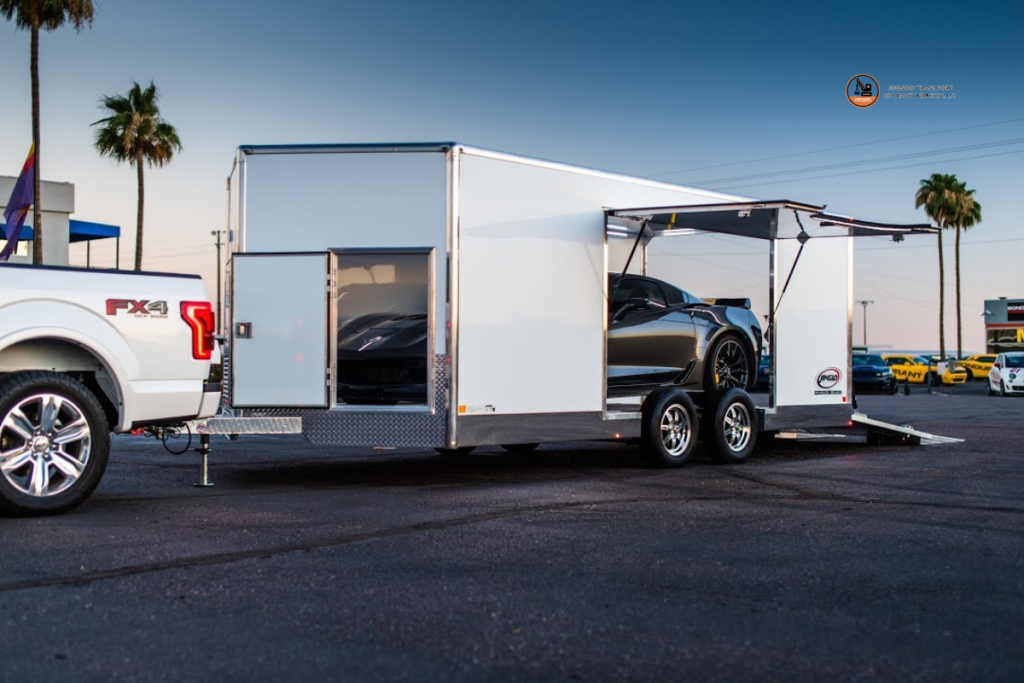
Find the best Car Trailer for safe and reliable vehicle transport. Explore features, uses, and tips for choosing the right car trailer for your needs.
There’s something satisfying about hauling your own car. Whether you’re moving a project car, helping a friend, or relocating across state lines, using a car hauling trailer gives you control and saves money. But here is the hard truth: towing is not like normal driving. It is a skill that requires respect, patience, and a lot of safety know-how.
At Jugnoo Transport, we’ve seen it all. From perfectly loaded trailers gliding down the highway to stressed-out drivers dealing with fishtailing rigs on the shoulder. Our goal is to make sure you are the former, not the latter. We are here to help you navigate the world of towing with confidence.
If you are looking for a car trailer rental or investing in your own equipment, this guide is for you. We will cover the basics and dive into some critical safety points that even experienced towers sometimes forget. We will talk about avoiding poor visibility and blind spots, understanding the risks of operating on unstable ground, and even touch on a concept borrowed from heavy machinery—overloading the boom and ignoring the load chart—because these ideas apply directly to your car transport trailer.
Let’s get you hitched and rolling safely.
1. The Foundation: Knowing Your Equipment and Limits
Before you even back up to the trailer, you need to do your homework. Towing is a partnership between your vehicle (the tow vehicle) and the car hauling trailer. If they aren’t compatible, the trip will end badly.
Match the Vehicle to the Trailer
You cannot just hook up any trailer to any car. Every vehicle has a tow rating. This number, found in your owner’s manual, tells you the maximum weight your vehicle can pull. But there is more to it than that.
You also need to look at the Gross Vehicle Weight Rating (GVWR). This is the maximum weight of your vehicle plus everything in it: passengers, luggage, and the tongue weight (the downward pressure the trailer puts on the hitch).
When you rent a car trailer rental from a place like Jugnoo Transport, we will ask about your vehicle. We do this to keep you safe. Exceeding your tow rating can cause transmission failure, brake failure, or loss of control. It is the fastest way to turn a safe trip into a dangerous one.
The Importance of the Load Chart
Now, here is where we borrow a concept from the construction world: the load chart. On a crane, the load chart tells the operator exactly how much weight they can lift at different angles and configurations. Ignoring the load chart on a crane leads to overloading the boom, causing the crane to tip over or collapse .
Your car transport trailer has a load chart too. It is called the GVWR of the trailer. This number is usually posted on the trailer’s frame. It tells you the absolute maximum weight of the car you are loading. Do not guess. Do not assume. If your car weighs 5,000 lbs and the trailer is rated for 4,500 lbs, you cannot use it.
Overloading the boom in crane terms means the arm breaks. Overloading the boom on your trailer means the frame bends, the tires blow, or the hitch snaps. The physics are the same: too much weight in the wrong place leads to catastrophic failure. Always check the ratings. It is the first and most important step.
2. The Art of Loading: Balance Is Everything
So, you have the right trailer for the job. Now comes the tricky part: getting the car onto the trailer. This is where most first-time towers get nervous, and rightfully so. A car hauling trailer requires the load to be just right.
Weight Distribution 101
You have probably heard the rule: keep it balanced. But what does that mean?
- Tongue Weight: For a standard car transport trailer, about 10-15% of the total weight should be pushing down on the hitch of your tow vehicle. If you are hauling a 4,000 lb car, you want about 400 to 600 lbs of tongue weight.
- Placement: You generally want the car positioned so that the center of mass is slightly forward of the trailer’s axles. This keeps the trailer stable. If the car is too far back, the tongue weight becomes too light. The trailer will start to sway back and forth like a fish. If it is too far forward, you might overload your tow vehicle’s rear axle and suspension.
Securing the Load
Once the car is in the right spot, you have to tie it down. Use the right equipment. Heavy-duty ratchet straps or chains are standard. Never use old, frayed, or damaged straps.
- Wheel Straps: The safest way to secure a vehicle is by the wheels. Wrap the straps around the tires and attach them to the tie-down points on the trailer.
- Emergency Brakes: Once the car is on the trailer, put it in park (or in gear for a manual transmission) and set the emergency brake. This prevents any movement inside the car while you are strapping it down.
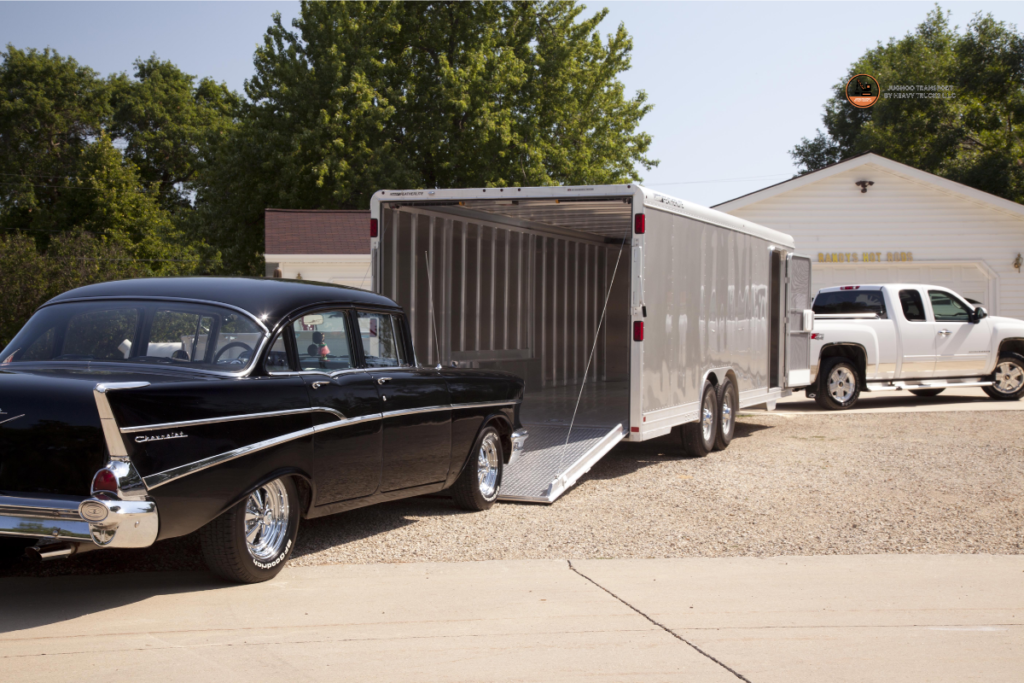
3. The Hidden Danger: Poor Visibility and Blind Spots
Once you are loaded up and ready to go, you need to think about what you can—and cannot—see. This is one of the most overlooked aspects of towing safety.
When you attach a car hauling trailer, you effectively block a huge portion of your rearview mirror. Your standard side mirrors might not be wide enough to see past the trailer. This creates poor visibility and blind spots that can hide entire cars, motorcyclists, or pedestrians .
Fixing the Blind Spots
You cannot drive safely if you cannot see. Here is how to fix poor visibility and blind spots:
- Extended Mirrors: If your tow vehicle doesn’t have large towing mirrors, invest in some clip-on extensions. They stick out further and allow you to see all the way down the sides of your trailer.
- The Spotter: When backing up, poor visibility and blind spots are even worse. You cannot see directly behind the trailer. Never back up without a spotter. Agree on hand signals before you start so there is no confusion.
- Be Aware of Length: Remember that your vehicle is now much longer. You have to pull further forward through intersections before turning so the trailer clears the curb. Check those blind spots twice before changing lanes.
4. Critical Hazards: Unstable Ground and Boom Logic
Now we come to two critical safety topics that are often overlooked by people renting a Car Trailer Rental for the first time. These concepts might sound like they belong on a construction site, but they apply directly to you.
The Risk of Operating on Unstable Ground
Think about where you load and unload your trailer. Is it on a nice, flat, paved driveway? Or is it on the side of a gravel road, a soft grassy lawn, or a muddy job site?
Operating on unstable ground is terrifyingly dangerous. When you drive a heavy car up the ramps onto a car transport trailer, the trailer wants to move. The weight transfers. If the trailer’s tires are sitting on soft dirt, mud, or uneven gravel, the trailer can tip sideways.
- The Jackknife: If the ground gives way, the trailer can lurch, causing the car to shift or the trailer to detach.
- The Tip-Over: If one side of the trailer sinks into soft ground while you are loading a heavy vehicle, the trailer can tilt. This can cause the vehicle to fall off.
How to avoid it: Always park your trailer on the firmest, most level ground you can find. If you are on a jobsite or a soft surface, use cribbing or heavy plywood pads under the trailer tires and the jack to spread the weight . Never rush a load on soft ground. If it feels squishy, it is unsafe. Operating on unstable ground is a leading cause of loading accidents because it compromises the entire structure before you even start moving .
Don’t Ignore the Load Chart (The Boom Principle)
Earlier we mentioned ignoring the load chart. Let’s dig deeper into why this is so important, and how it relates to the boom.
In crane operations, ignoring the load chart leads to overloading the boom. The boom is the long arm that does the lifting. If you put too much weight on the end of it, or if you extend it too far out, the stress is too much and the boom snaps or the crane tips .
Your car transport trailer doesn’t have a boom, but it has a frame and axles. When you overload it, you are bending that frame. When you put a car with a very long wheelbase on a short trailer, you are creating leverage that the trailer wasn’t designed for. The trailer becomes the boom.
Overloading the boom on a trailer looks like this:
- The trailer frame starts to bend or sag in the middle.
- The tires rub against the fenders because the axles are bending.
- The trailer fishtails violently because the weight is too much for the suspension to control.
By ignoring the load chart (the manufacturer’s weight limits), you are betting that your trailer is stronger than the engineers said it was. That is a losing bet. Respect the numbers. If you need to haul a heavier car, you need a heavier trailer. At Jugnoo Transport, we make sure you get the right size for your specific vehicle so you never have to worry about this.
5. Hooking Up: The Devil is in the Details
You have the right trailer, the car is loaded safely, and you are on stable ground. Now, double-check the connection between the tow vehicle and the trailer. This is where small mistakes cause big problems.
The Hitch and Ball
Make sure the hitch ball is the right size for the trailer coupler. Common sizes are 1-7/8 inches and 2 inches . They look similar, but using the wrong size allows the trailer to bounce off the ball. Also, ensure the hitch is rated for the weight you are carrying. A Class III hitch is rated for different weights than a Class I.
Safety Chains
Always cross your safety chains underneath the trailer tongue. Why? If the trailer detaches, the crossed chains form a cradle that catches the tongue, preventing it from digging into the pavement . Leave enough slack in the chains for turning, but don’t let them drag on the ground.
Breakaway Cable
Most car hauling trailers have a small cable with a pin or clip. This is the breakaway brake system. This cable must be attached to your tow vehicle (not the ball or hitch, but the frame or the safety chain loop). If the trailer comes loose, this cable pulls a pin that activates the trailer’s emergency brakes, stopping it from becoming a 3,000-pound missile .
Lights and Bearings
Plug in the electrical connector. Walk around the trailer. Check:
- Turn Signals: Are they flashing?
- Brake Lights: Do they light up when you press the pedal?
- Running Lights: Can other drivers see the outline of your trailer at night?
- Wheel Bearings: Are they greased and cool? If you just drove, feel the hub for excessive heat (but don’t burn yourself). Excessive heat means a bearing is failing.
6. Driving Dynamics: Staying in Control
Driving with a car transport trailer is a different experience. The vehicle feels heavy. It takes longer to stop. It sways in the wind. Here is how to handle it.
Speed Limits
The ideal towing speed is often lower than the posted speed limit. Many experts, including major rental companies, recommend staying at or below 55 mph . Tires heat up more when towing. Higher speeds make trailer sway worse. High speeds reduce your reaction time. Slow down. It is the single best thing you can do for safety.
Braking and Following Distance
Leave a massive gap between you and the car in front of you. Your combined weight means you need much more distance to stop. If the car in front of you slams on their brakes, you need that space to react. A good rule of thumb is the 4-second rule or more. Pick a stationary object. When the car in front passes it, count one-thousand-one, one-thousand-two, one-thousand-three, one-thousand-four. If you pass the same object before you finish counting, you are following too closely .
Handling Curves and Hills
- Curves: Brake before the curve, not during it. Slowing down while turning can cause the trailer to jackknife. Enter the curve slowly, and gently accelerate through it to stabilize the rig .
- Downhill: Shift your tow vehicle into a lower gear. This uses engine braking to control your speed, rather than riding your brake pedal until they overheat and fade .
- Uphill: You will lose speed. That is okay. Move to the right lane and turn on your hazard lights if you are going significantly slower than traffic.
Dealing with Sway (The Whipping Effect)
If you feel the trailer starting to wiggle or sway back and forth, do not panic. This is often called whipping .
- DO NOT slam on the brakes. This makes it worse.
- DO NOT speed up.
- DO take your foot off the gas pedal. Let the vehicle slow down gradually.
- Gently hold the steering wheel straight.
As you lose speed, the sway should stop. Once you are under control, pull over at the next safe spot and check your load. Something is probably out of balance .
7. Pre-Trip Checklist: Your Roadmap to Safety
Before you head out, use this simple checklist from Jugnoo Transport to make sure everything is good to go.
- Tow Vehicle Check: Are the tires inflated (including the spare)? Is the oil and transmission fluid full? Is the hitch bolted on tightly?
- Trailer Check: Are the trailer tires inflated to the correct pressure (check the sidewall)? Are all lug nuts tight? Are the wheel bearings greased?
- Connection Check: Is the coupler tightly fastened to the ball? Is the safety pin in place? Are the safety chains crossed and attached? Is the breakaway cable attached to the vehicle?
- Lighting Check: Are all lights working? Brakes, turn signals, and running lights.
- Load Check: Is the car strapped down? Are the straps tight and not rubbing on sharp edges? Is the car in gear with the parking brake on? Is the tongue weight correct?
- Mirror Check: Can you see past the sides of the trailer? If not, adjust your mirrors or add extensions to combat poor visibility and blind spots.
8. Why Choose Jugnoo Transport?
At Jugnoo Transport, we don’t just hand you the keys and wave goodbye. We believe in education and safety. We know that a safe customer is a happy customer.
When you come to us for a car trailer rental, we take the time to walk you through the setup. We will show you how the coupler works, where the safety chains go, and how to properly distribute the weight on our car transport trailer. We offer a range of well-maintained trailers, from lightweight aluminum rigs to heavy-duty steel car hauling trailer options.
Our team understands the roads you will be traveling. We know the importance of avoiding operating on unstable ground when loading, and we emphasize why ignoring the load chart on your rental is simply not an option. We equip every trailer with the necessary safety gear and make sure you leave our lot confident, not confused.
We also know that towing can be intimidating because of poor visibility and blind spots. We will help you adjust your mirrors and give you tips for using spotters so you can navigate parking lots and busy streets with ease.
Whether you are a first-time tower or a seasoned pro, Jugnoo Transport is your partner in safe hauling. We provide the equipment, the advice, and the support you need to get your vehicle from point A to point B without drama.
Conclusion
Towing a vehicle is a big responsibility. It requires patience, preparation, and respect for the laws of physics. Whether you are picking up a classic car, delivering a vehicle to a new owner, or moving your daily driver, using a car hauling trailer safely should be your number one goal.
Remember these key points:
- Know your limits: Check the weight ratings of your vehicle and your car transport trailer. Don’t play guessing games.
- Load it right: Balance the weight and secure the car tightly.
- See and be seen: Fix those blind spots. Never reverse without a spotter.
- Respect the ground: Ensure your setup is stable before loading. Operating on unstable ground is an accident waiting to happen.
- Understand the load: Remember the crane principle. Overloading the boom or ignoring the load chart on your trailer leads to broken equipment and dangerous situations.
- Drive smart: Slow down, leave space, and know how to handle sway.
At Jugnoo Transport, we are here to help you every mile of the way. Next time you need a reliable car trailer rental, give us a call. We will get you set up with the perfect trailer and the knowledge you need to haul with confidence.
Safe travels, and we hope to see you soon at Jugnoo Transport