
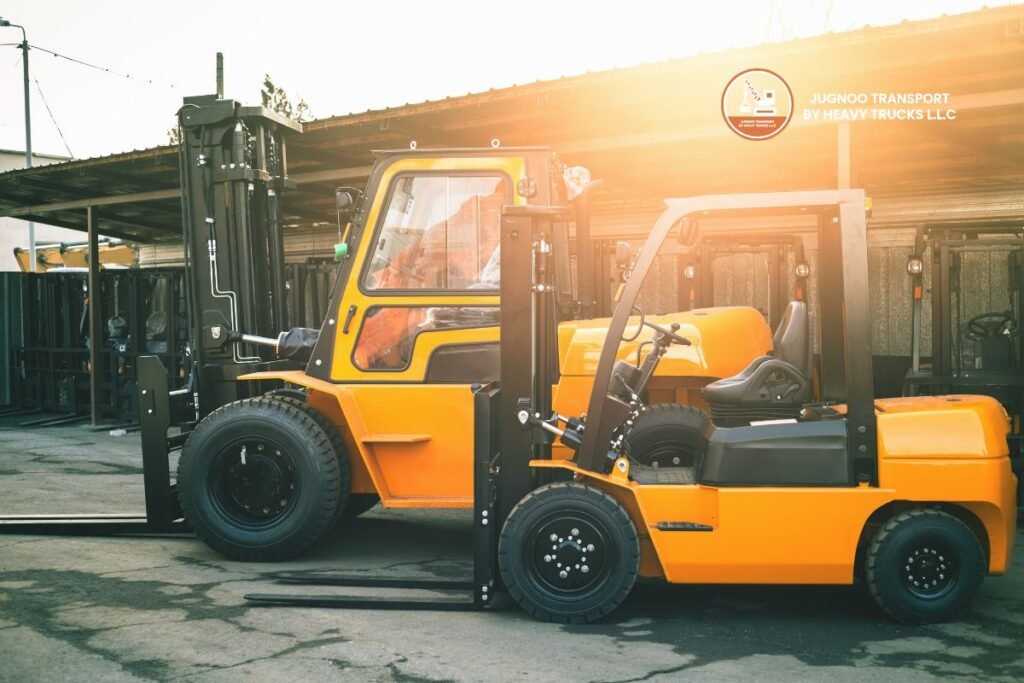
Choosing between a diesel and electric forklift in Dubai is not simply a question of which machine is more powerful or less expensive.
The right choice depends on where the forklift will operate, how long it needs to work, the load being handled, ventilation, surface conditions, charging availability and the overall demands of the project.
For example, an electric forklift can be an excellent option for indoor warehouse operations where quiet operation and the absence of engine exhaust at the point of use are important. Diesel forklifts, on the other hand, are commonly selected for demanding outdoor applications, construction environments and heavy material handling where long operating periods and quick refuelling can be valuable.
Jugnoo Transport provides both diesel and electric forklift rental options in Dubai, with capacities ranging from 3 to 20 tons for warehouse, construction, logistics and industrial applications.
This guide compares diesel and electric forklifts so you can understand which option may be more suitable for your project.
Quick Answer: Diesel or Electric Forklift?
Choose an electric forklift when your work is mainly indoors, particularly in warehouses, manufacturing facilities and other environments where lower noise and no tailpipe exhaust during operation are important.
Choose a diesel forklift when your work is primarily outdoors, involves demanding material handling, requires longer continuous operating periods or takes place on construction and industrial sites.
However, power source should not be selected in isolation. Forklift capacity, load dimensions, site surface, lifting height, operating hours and equipment configuration must also be considered.
What Is a Diesel Forklift?
A diesel forklift uses a diesel internal-combustion engine to power lifting and movement.
These machines are commonly associated with demanding outdoor applications because diesel engines can provide strong torque, extended operating periods and quick refuelling.
Typical diesel forklift applications include:
- Construction sites
- Industrial yards
- Heavy cargo handling
- Outdoor warehouses
- Logistics yards
- Machinery movement
- Loading and unloading
- Building-material handling
Diesel forklifts are particularly relevant where a machine needs to operate for extended periods without stopping for battery charging. Toyota identifies outdoor construction, lumber-yard and heavy material-handling operations as typical diesel applications.
What Is an Electric Forklift?
An electric forklift uses rechargeable batteries rather than a diesel engine.
Depending on the machine, batteries may use technologies such as lead-acid or lithium-ion.
Electric forklifts are particularly well suited to indoor material-handling environments because they operate quietly and do not produce engine exhaust from a tailpipe during use. They also generally contain fewer moving drivetrain components than internal-combustion forklifts.
Common applications include:
- Warehouses
- Distribution facilities
- Manufacturing operations
- Indoor loading areas
- Storage facilities
- Retail distribution
- Indoor material movement
Some modern electric forklift models can also operate outdoors when their design, tyres, weather protection and surface conditions are appropriate, so electric should not automatically be interpreted as “indoor only.”
Diesel vs Electric Forklift: Quick Comparison
| Factor | Diesel Forklift | Electric Forklift |
|---|---|---|
| Best environment | Primarily outdoor/heavy-duty | Primarily indoor/controlled |
| Exhaust at point of use | Yes | No tailpipe exhaust |
| Noise | Higher | Lower |
| Refuelling/charging | Quick refuelling | Battery charging required |
| Long continuous shifts | Often advantageous | Depends on battery/charging strategy |
| Heavy outdoor work | Strong choice | Model/application dependent |
| Warehouse work | Site/ventilation dependent | Strong choice |
| Maintenance | Engine-related maintenance | Generally fewer moving powertrain parts |
| Charging infrastructure | Not required | Required |
| Rough outdoor surfaces | Often better suited | Depends on model and tyres |
The table provides general guidance rather than a substitute for selecting a specific forklift model for the actual load and site.
When Should You Rent a Diesel Forklift in Dubai?
A diesel forklift may be the better rental choice when your project takes place mainly outdoors or involves demanding material handling.
Construction Sites
Construction environments can involve:
- Building materials
- Steel
- Heavy pallets
- Fabricated components
- Machinery
- Site equipment
Outdoor conditions and longer operating periods often favour diesel-powered equipment.
If the project also involves uneven or demanding surfaces, the machine’s tyre configuration and ground clearance should be considered in addition to its fuel type.
Industrial Yards
Industrial facilities may need forklifts for moving heavy components between workshops, loading areas and outdoor storage spaces.
Diesel forklifts can be useful where:
- Loads are heavy
- Operating hours are long
- Outdoor movement is frequent
- Fast refuelling is important
Heavy Cargo Handling
High-capacity material handling may include:
- Industrial machinery
- Generators
- Steel structures
- Large fabricated items
- Heavy crates
- Construction materials
Diesel forklifts are widely used for demanding outdoor and higher-intensity operations because of their torque and operating characteristics.
Long Operating Periods
Battery technology has improved considerably, but project scheduling still matters.
A diesel machine can generally be refuelled quickly, while electric forklift operations need an appropriate charging strategy.
For a short rental project requiring long continuous operating hours, diesel may therefore be practical when site conditions permit.
When Should You Rent an Electric Forklift in Dubai?
Electric forklifts can be particularly valuable where the working environment makes emissions, noise and manoeuvrability important.
Warehouses
Warehouses are one of the most common environments for electric forklifts.
They can be useful for:
- Pallet movement
- Loading and unloading
- Storage operations
- Material positioning
- Indoor inventory handling
Electric forklifts are commonly recommended for indoor warehouse and manufacturing environments because of quieter operation and lower point-of-use emissions.
Indoor Manufacturing Facilities
Factories may require forklifts to move:
- Raw materials
- Components
- Finished goods
- Equipment
- Palletised products
Electric operation can reduce engine noise inside the facility and avoids diesel exhaust at the point of operation.
Ventilation and workplace requirements should still be assessed as part of overall site planning.
Noise-Sensitive Environments
Electric forklifts generally produce less operating noise and vibration than internal-combustion machines.
This can be useful where:
- Several machines operate indoors
- Communication between workers is important
- Noise control matters
- Operations take place near occupied areas
Electric forklifts are not silent—alarms, tyres, hydraulics and load handling still produce sound—but their drivetrain is typically considerably quieter than a diesel engine.
Indoor vs Outdoor Use: The Most Important Difference
For many Dubai projects, working environment is the simplest starting point.
If the forklift will spend most of its time inside a warehouse, an electric forklift may be the logical first option to consider.
If it will spend most of its time outside on a construction site or industrial yard, diesel may be more practical.
But this is not an absolute rule.
Modern electric pneumatic forklifts can perform certain outdoor applications, while internal-combustion forklifts can sometimes operate in suitable indoor environments subject to ventilation and site requirements. The specific model and application matter.
What About Dubai’s Heat?
Dubai’s climate makes operating conditions an important consideration for any forklift.
High temperatures can affect equipment operation regardless of whether the machine is diesel or electric.
For electric forklifts, battery type, charging environment, battery-management systems and manufacturer operating limits should be considered.
For diesel machines, cooling systems, fluids and general machine condition remain important during demanding outdoor work.
Rather than assuming one power type is automatically better in hot conditions, confirm that the specific forklift is designed and maintained for the intended operating environment.
Runtime: Which Forklift Can Work Longer?
Runtime depends heavily on the actual machine and job.
Diesel forklifts can be quickly refuelled and returned to operation, making them useful for demanding or extended shifts.
Electric forklift runtime depends on:
- Battery capacity
- Battery technology
- Load intensity
- Travel distance
- Lifting frequency
- Attachments
- Charging strategy
Toyota states that a fully charged electric forklift battery can often support around 6–8 hours of moderate use, although actual runtime varies substantially with equipment and application.
Therefore, don’t select a forklift based only on a generic runtime figure.
For rental projects, tell the supplier how many hours per day the forklift will actually be operating.
Charging vs Refuelling
This can significantly affect operational planning.
A diesel forklift requires access to suitable fuel and can generally return to service quickly after refuelling.
An electric forklift requires charging infrastructure and enough time or battery strategy to support the planned shifts.
Before renting an electric forklift, confirm:
- Available electrical supply
- Charger requirements
- Charging location
- Planned operating hours
- Battery runtime
- Whether multiple shifts are required
For short indoor projects, this may be simple.
For continuous multi-shift operations, charging strategy becomes much more important.
Which Forklift Is Better for Heavy Loads?
Do not assume diesel automatically means higher lifting capacity.
Forklift capacity is determined by the specific machine, not simply its power source.
Jugnoo Transport currently advertises forklift rental capacities from 3 to 20 tons and offers both diesel and electric options.
When selecting a forklift for heavy machinery or cargo, consider:
- Load weight
- Load dimensions
- Load centre
- Required lifting height
- Fork length
- Attachments
- Site conditions
A 5-ton diesel forklift does not become suitable for a 10-ton load merely because it uses diesel.
The rated capacity and load chart remain critical.
Which Forklift Is Better for Container Loading?
It depends on how the loading operation is arranged.
Diesel forklifts are commonly used for outdoor cargo and container-handling environments because of their suitability for demanding external operations.
However, the correct machine should also be selected according to:
- Cargo weight
- Container dimensions
- Forklift access
- Turning space
- Ground surface
- Fork length
- Load centre
Some container operations may require specialised forklifts or different lifting equipment altogether.
Which Forklift Is Better for a Warehouse?
For predominantly indoor warehouse work, electric forklifts are usually the stronger starting point.
Advantages can include:
- No tailpipe exhaust during use
- Lower operating noise
- Lower vibration
- Good manoeuvrability
- Suitability for controlled indoor environments
Electric forklifts are widely used in warehousing, manufacturing and distribution applications for these reasons.
However, charging requirements and expected operating hours still need to be planned.
Does Electric Mean Lower Rental Cost?
Not necessarily.
Forklift rental cost depends on much more than fuel type.
Important factors include:
- Capacity
- Rental duration
- Machine specification
- Site location
- Transportation
- Required working hours
- Attachments
- Operator requirements
- Availability
A smaller electric forklift and a heavy-capacity diesel forklift serve different applications, so comparing rental prices without comparing specifications can be misleading.
The best approach is to request a quotation for the machine that actually matches the job.
Need Help Choosing Diesel or Electric?
Instead of requesting a forklift based only on fuel type, send Jugnoo Transport:
- Load weight
- Load dimensions
- Lifting height
- Indoor or outdoor location
- Ground conditions
- Required working hours
- Project location
- Rental duration
CTA: Get a Forklift Recommendation
These details make it easier to identify both the correct forklift capacity and appropriate power type.
How to Choose Between Diesel and Electric Forklift Rental
Use these five questions before booking.
Where will the forklift operate? Indoor warehouses generally favour electric machines, while outdoor construction and industrial environments often favour diesel.
How heavy is the load? Select capacity first. Fuel type cannot compensate for insufficient rated lifting capacity.
How many hours will it work? Long or multi-shift operations require careful consideration of refuelling or battery charging.
What are the site restrictions? Check ventilation, noise requirements, door dimensions, floor surface, turning space and charging availability.
Will the machine work indoors and outdoors? If both environments are involved, discuss the exact operating conditions with the rental provider. Certain electric models are capable of indoor/outdoor operation, while the suitability of diesel machines indoors depends strongly on site and ventilation conditions.
Diesel Forklift Advantages
Diesel forklifts can provide several advantages for appropriate applications:
- Strong performance in demanding outdoor work
- Quick refuelling
- Good suitability for extended shifts
- Strong torque for heavy material handling
- Suitability for many construction and industrial applications
Their main trade-offs include engine exhaust, higher operating noise and engine-related maintenance requirements.
Electric Forklift Advantages
Electric forklifts can provide advantages such as:
- No tailpipe exhaust during operation
- Lower operating noise
- Lower vibration
- Fewer moving powertrain components
- Strong suitability for indoor warehouse applications
- Rechargeable energy source
Their practical considerations include charging infrastructure, battery runtime and ensuring that the selected machine is suitable for the site and weather conditions.
Why Rent From Jugnoo Transport?
Jugnoo Transport provides forklift rental for warehouse, construction, industrial and logistics operations across Dubai and the UAE.
Its current forklift offering includes:
- 3 to 20 ton capacities
- Diesel and electric models
- Short- and long-term rental
- Operator support
- Indoor and outdoor applications
The company also states that forklifts are available for hourly, daily and monthly rental requirements.
Rather than selecting a forklift only by capacity or fuel type, share the complete project requirement so the appropriate equipment can be considered.
Frequently Asked Questions
Is a diesel or electric forklift better for indoor use?
Electric forklifts are generally better suited to predominantly indoor warehouse and manufacturing operations because they produce no tailpipe exhaust during use and operate more quietly. The specific machine, facility and application should still be assessed.
Is a diesel forklift better for construction sites?
Diesel forklifts are commonly used for outdoor construction and industrial work because they provide strong torque, quick refuelling and suitability for demanding operating conditions.
Can electric forklifts work outdoors in Dubai?
Some electric forklifts are designed for outdoor operation, particularly models with suitable pneumatic tyres and weather protection. Outdoor suitability depends on the specific forklift, ground conditions and manufacturer’s specifications.
Which forklift is cheaper to rent in Dubai?
There is no universal answer. Rental price depends on forklift capacity, equipment specification, duration, transportation, project location and availability as well as power type. Requesting a quotation based on the actual job gives a more meaningful comparison.
Which forklift is better for long working hours?
Diesel forklifts can be practical for extended operation because they can be refuelled quickly. Electric forklifts can also support long shifts when battery capacity and charging are properly planned. The best option depends on the duty cycle and available infrastructure.
Do electric forklifts produce emissions?
Electric forklifts have no tailpipe exhaust during operation. This makes them particularly suitable for many indoor environments. It is more accurate to say “zero tailpipe emissions during operation” rather than claiming that the entire lifecycle of the equipment produces zero emissions.
What forklift sizes does Jugnoo Transport offer?
Jugnoo Transport currently advertises forklifts ranging from 3 to 20 tons, including diesel and electric models for different indoor and outdoor requirements.
Rent the Right Forklift for Your Dubai Project
The decision between a diesel vs electric forklift should be based on the actual working environment rather than personal preference.
For indoor warehouse operations, electric forklifts are often the better starting point because of lower noise and no tailpipe exhaust during operation.
For outdoor construction sites, industrial yards and demanding heavy-material handling, diesel forklifts may provide greater operational flexibility.
But power source is only one part of forklift selection.
Before renting, confirm:
- Load weight
- Load dimensions
- Required lifting height
- Indoor or outdoor use
- Ground conditions
- Required working hours
- Project location
- Rental duration
Jugnoo Transport can then assess whether a diesel or electric forklift—and which capacity—is better suited to the requirement.