
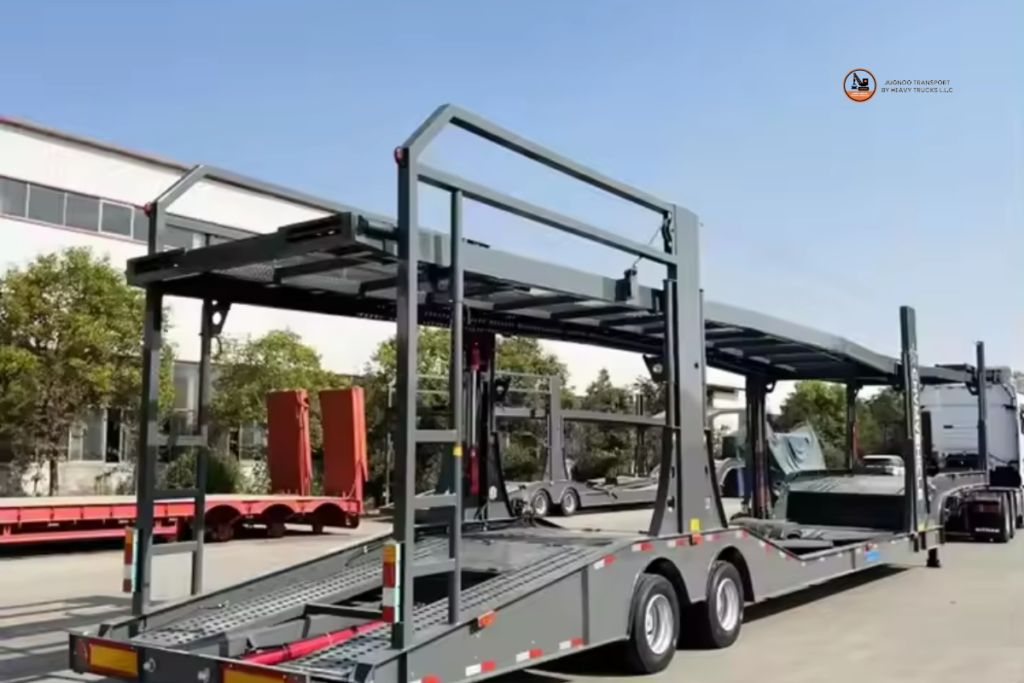
Trailer Vehicle solutions for safe towing, transport, and heavy-duty hauling. Learn types, uses, features, and benefits for commercial needs.
If you have ever driven down a highway and seen a massive piece of machinery—like a bulldozer or a shipping container—rolling down the road, you have witnessed the magic of a trailer vehicle.
In the world of logistics and construction, the trailer vehicle is the unsung hero. It takes the weight off the road (literally) and allows businesses to move goods that would otherwise be impossible to transport.
At Jugnoo Transport, we live and breathe heavy logistics. We have seen the good, the bad, and the oh no of the hauling industry. Whether you are a small business owner looking to move equipment or a project manager planning a massive infrastructure build, understanding the ins and outs of trailer vehicles is critical.
Will walk you through everything you need to know: from the various trailer vehicle types, to the advantages of trailer vehicle rental, and how to avoid catastrophic mistakes like Overloading the Boom, Ignoring the Load Chart.
Let’s hitch up and get rolling.
What Exactly is a Trailer Vehicle?
Before we dive into the heavy stuff, let’s clarify the basics.
A trailer vehicle is a non-motorized unit designed to carry cargo. It is pulled by a powered vehicle—usually a truck or tractor. Unlike a standard truck where the engine and cargo space are one unit, a trailer vehicle separates the pulling power from the carrying power.
Why does this matter?
Because separation equals flexibility. You can drop off one trailer, pick up another, and keep the engine running while the trailer sits at a loading dock. This efficiency is the backbone of modern supply chains.
At Jugnoo Transport, we often describe a trailer vehicle as the workhorse that never complains. It doesn’t have an engine, but it carries the weight of the world—sometimes literally.
The Many Faces of Trailer Vehicle Types
Not all cargo is created equal. You wouldn’t haul a yacht on the same trailer you use for bricks. Understanding trailer vehicle types is the first step to ensuring safety and efficiency.
Here are the most common categories we deal with at Jugnoo Transport:
- Flatbed Trailers
This is the most common type. It has no sides or roof. It looks like a flat platform on wheels.
Best for: Steel beams, pipes, lumber, and machinery.
Why use it? Easy loading from above or the sides.
- Lowboy Trailers (Low Loaders)
These trailers have a drop-deck design that lowers the cargo height. This allows you to transport tall equipment without hitting bridges or power lines.
Best for: Excavators, bulldozers, and heavy construction gear.
- Refrigerated Trailers (Reefers)
These are insulated boxes with a cooling unit.
Best for: Perishable food, flowers, and medical supplies.
- Dry Van Trailers
The classic box trailer. Fully enclosed to protect cargo from weather and theft.
Best for: General freight, furniture, and palletized goods.
- Heavy Haul Trailers
When standard trailers aren’t enough, you step up to a heavy trailer vehicle. These are built with reinforced frames, more axles, and higher weight capacities. They are designed specifically for extreme loads—think transformers, wind turbine blades, and massive industrial presses.
- Extendable Trailers
These trailers can stretch to accommodate longer items.
Best for: Pipes, poles, and structural steel.
Knowing these trailer vehicle types ensures you don’t force a square peg into a round hole. It saves time, money, and lives.
The Smart Move: Trailer Vehicle Rental
Now that you know what kind of trailer exists, the next question is: Should you buy one or rent one?
For many businesses, the answer is trailer vehicle rental.
At Jugnoo Transport, we highly advocate for renting—especially if you are not using heavy equipment 365 days a year. Here is why:
- Capital Preservation
That is a lot of cash to park in your yard. When you opt for a trailer vehicle rental, you keep your working capital available for payroll, marketing, and expansion.
- Maintenance Headaches
Trailers break. Tires blow. Brakes wear. Bearings fail. When you own a fleet, you own the repair bills. When you rent, the maintenance is someone else’s problem.
- Seasonal Flexibility
Do you need five extra trailers in December but only one in February? Renting allows you to scale up and down instantly.
- Specialized Needs
If you need a heavy trailer vehicle for a one-time power plant delivery, renting is the only logical choice. Why buy a million-pound hauler that will sit idle for 11 months?
At Jugnoo Transport, we offer flexible trailer vehicle rental options tailored to your project duration. Whether you need a unit for a day, a week, or a year, we have you covered.
The Benefits You Can’t Ignore
Why do businesses rely so heavily on trailer vehicles? The benefits go beyond just moving stuff.
- Increased Payload Capacity
A standard delivery truck has limits. By using a trailer vehicle, you effectively double (or triple) your carrying capacity per trip. Fewer trips mean lower fuel costs and less labor.
- Versatility
With a tractor and a variety of trailers, you can haul dry goods one day and liquid asphalt the next. You simply swap the box.
- Reduced Wear and Tear
If you overload a rigid truck, you destroy the chassis. With a trailer vehicle, the weight is distributed across multiple axles, reducing strain on the pulling unit.
- Profitability
For owner-operators, the trailer is the income generator. The more you can haul legally and safely, the more you earn.
The Dark Side of Hauling—Mistakes That Kill
We have discussed the what and the why. Now we need to discuss the don’t.
At Jugnoo Transport, we don’t just rent equipment; we educate our clients on safe operation. The trailer vehicle is a powerful tool, but in the wrong hands, it is a weapon.
Here are four deadly sins in the trailer world.
Overloading the Boom, Ignoring the Load Chart
This is the number one mistake we see, especially with crane operations and boom trucks.
Every trailer and lifting device comes with a load chart. This chart is not a suggestion; it is the law of physics printed on paper.
When operators engage in Overloading the Boom, Ignoring the Load Chart, they are betting against gravity. The boom is designed to lift a specific weight at a specific angle. If you exceed that, the boom can buckle, the trailer can flip, or the hydraulics can fail.
Why does this happen?
- Rushing to meet a deadline.
- Assuming the equipment is built tough.
- Misjudging the weight of the cargo.
The Jugnoo Way:
We always ask for the exact weight and dimensions before dispatching equipment. If you don’t know the weight, we help you calculate it. A few extra minutes of math can save you thousands in repairs and lawsuits.
Operating on Unstable Ground
A trailer vehicle is designed to roll on paved or compacted surfaces. Unfortunately, job sites are rarely perfect.
Operating on Unstable Ground is a recipe for disaster. When the ground gives way under the weight of a heavy trailer vehicle, the results are terrifying. The trailer can sink, tip over, or become stuck.
Common unstable ground scenarios:
- Soft dirt after rain.
- Uncompacted fill dirt.
- Sloped shoulders on rural roads.
How to prevent it:
- Use ground mats to distribute weight.
- Walk the path before driving.
- If the ground looks soft, it probably is.
At Jugnoo Transport, we assess the delivery site before we ever send a trailer. If the ground is questionable, we recommend alternatives or specialized equipment like wide-flotation tires.
Poor Visibility and Blind Spots
A trailer vehicle is long. Very long. When you attach a 53-foot trailer to a truck, you instantly create massive blind spots.
Poor Visibility and Blind Spots are the leading causes of accidents involving trailer vehicles. Cars sneak up on the right side. Pedestrians appear between the tractor and the trailer. Children on bicycles ride alongside.
The Danger:
Drivers often forget that the back of the trailer is a football field away from the cab. Turning right requires swinging wide. Backing up requires a spotter.
The Solution:
- Always use convex mirrors.
- Install backup cameras.
- Never reverse without a guide.
- Assume someone is in your blind spot.
At Jugnoo Transport, we equip our rental fleet with safety reflectors and ensure all hitches are visible. We also remind drivers daily: if you can’t see them, they aren’t safe.
Skipping the Pre-Trip Inspection
This isn’t as dramatic as a boom collapsing, but it is just as dangerous.
A flat tire at 60 mph can cause the trailer to whip violently. A broken light can lead to a rear-end collision. A loose chain can become a projectile.
The Checklist:
- Tire pressure and tread depth.
- All lights and turn signals.
- Hitch and safety chains.
- Brake connections.
- Load securement (straps, chains, binders).
At Jugnoo Transport, we inspect every trailer vehicle before it leaves our yard. But once it’s in your hands, the responsibility is yours.
How to Choose the Right Trailer Vehicle for Your Job
Feeling overwhelmed? Don’t be.
Choosing the right trailer vehicle is a process of elimination. Ask yourself these five questions:
- What is the weight? (This determines the number of axles and the type of trailer.)
- What are the dimensions? (Height and width matter for permits and routing.)
- Is it sensitive to weather? (If yes, you need an enclosed van.)
- How will it be loaded? (Do you need a ramp? A crane? A forklift?)
- What is the route? (Are there low bridges? Narrow roads?)
If you answer these honestly, you will land on the right trailer vehicle types 90% of the time.
Still unsure? Call Jugnoo Transport. We do this every day. We can look at a photo of your cargo and tell you exactly what you need.
The Future of Trailer Vehicles
The trailer industry is not stuck in the past. Innovation is happening fast.
- Electric Trailer Axles
These are smart axles that generate power as they roll, assisting the truck and saving fuel.
- Telematics
Trailers now come with GPS tracking, tire pressure monitoring, and brake temperature sensors. This data helps prevent breakdowns before they happen.
- Lightweight Materials
Aluminum and composite materials are replacing steel in many components. Lighter trailers mean higher legal payloads.
- Autonomous Convoys
While we aren’t there yet, driverless trucks pulling sensor-laden trailers are being tested on highways.
At Jugnoo Transport, we stay ahead of the curve. We continuously upgrade our rental fleet to include the latest safety and efficiency features.
Why Jugnoo Transport is Your Best Partner
You now know the theory. You know the equipment.
Now, let’s talk about execution.
At Jugnoo Transport, we don’t just hand you the keys and wave goodbye. We are a service-first logistics firm. Whether you need a **heavy trailer vehicle** for a massive infrastructure project or a simple flatbed for a local move, we treat every load like it’s our own.
Our Promise to You:
- Quality Equipment: No rust buckets. No bald tires. No broken lights.
- Transparent Pricing: No hidden fees. No surprise charges.
- Expert Advice: We help you match the load to the right trailer.
- 24/7 Support: Breakdowns don’t wait for business hours, and neither do we.
We understand that your cargo is your livelihood. When you trust Jugnoo Transport with your trailer vehicle rental, you aren’t just renting steel; you are buying peace of mind.
Real-World Scenarios
Let’s look at how these principles play out in real life.
The Farmer
Challenge: A farmer needs to move a combine harvester from one field to another, 30 miles away. The combine is 14 feet tall.
Mistake: Using a standard flatbed. The height exceeds legal limits.
Solution: A lowboy trailer vehicle from Jugnoo Transport. The drop deck reduces the height, avoiding power lines and overpasses.
The Contractor
Challenge: A contractor needs to deliver a 40-ton excavator to a residential development site. The site entrance is soft dirt.
Mistake: Operating on Unstable Ground without preparation.
Solution: Jugnoo Transport recommends using ground mats and a heavy trailer vehicle with multiple axles to distribute weight.
The Crane Operator
Challenge: Lifting heavy HVAC units onto a rooftop.
Mistake: Overloading the Boom, Ignoring the Load Chart.
Solution: At Jugnoo Transport, we provide load charts with every rental and ensure operators are trained to read them.
Maintenance Tips for Trailer Owners
If you do decide to own a trailer vehicle (or if you rent one long-term), maintenance is key.
- Grease the Bearings
Wheel bearings need grease every 10,000 to 12,000 miles. Dry bearings overheat and lock up.
- Check the Suspension
Leaf springs can crack. Air bags can leak. A smooth ride means the suspension is working.
- Inspect the Deck
Wood decks rot. Steel decks rust. A hole in the deck can swallow a forklift wheel.
- Test the Lights
Corroded wiring is the enemy. Carry spare bulbs and connectors.
- Tighten the Bolts
Vibration loosens everything. Go over the trailer with a wrench periodically.
Legal and Regulatory Considerations
You can’t just hook up and go. There are rules.
Weight Limits
Every state has maximum gross vehicle weight ratings (GVWR). Exceed them, and you face fines and out-of-service orders.
Permits
Oversize loads require special permits. This includes loads over 8.5 feet wide or 13.5 feet high.
CDL Requirements
Not every trailer requires a Commercial Driver’s License, but most heavy hauling does.
Insurance
Cargo insurance covers the product you are hauling. Liability insurance covers the damage you cause.
At Jugnoo Transport, we handle the heavy lifting on permits and compliance. We ensure your trailer vehicle rental is legal and safe before it hits the road.
Common Myths About Trailer Vehicles
Let’s bust some myths.
Myth 1: All trailers are the same.
False. A trailer built for logs is not built for gravel. Axle placement, floor material, and suspension vary widely.
Myth 2: More weight on the hitch is better.
False. Too much tongue weight can overload the truck’s rear axle. Too little tongue weight causes trailer sway.
Myth 3: Rental trailers are beaten up.
Not at Jugnoo Transport. We pride ourselves on maintaining a young, clean fleet.
Myth 4: You don’t need a spotter.
You always need a spotter. Poor Visibility and Blind Spots don’t disappear with experience.
The Emotional Side of Hauling
We’ve talked steel, weight, and regulations. But there is a human side to this business.
Every driver pulling a heavy trailer vehicle carries the weight of responsibility. They carry the hopes of a supplier who needs to get paid. Carry the timeline of a construction crew waiting on materials. They carry the safety of every motorist sharing the road.
At Jugnoo Transport, we honor that responsibility. We don’t just rent trailers; we support the people who drive them.
Why Jugnoo?
You might wonder about our name. Jugnoo means a small lamp or a light.
In the darkness of early morning logistics, in the chaos of a busy job site, in the stress of a tight deadline—we aim to be that light.
We illuminate the path forward. Help you see clearly so you don’t fall into the traps of Overloading the Boom, Ignoring the Load Chart, or Operating on Unstable Ground.
We are Jugnoo Transport. And we are here to help you move forward.
Your Action Plan
You’ve read the guide. Now, what do you do?
1: Assess your upcoming project.
2: Determine the weight, size, and nature of your cargo.
3: Match it to the correct trailer vehicle types.
4: Decide if buying or trailer vehicle rental makes sense.
5: Contact Jugnoo Transport for a quote.
Don’t wait until the job starts. Plan your transport the same way you plan your budget and your labor.
Conclusion
The humble trailer vehicle is the backbone of industry. It moves the machines that build our cities, the food that fills our tables, and the goods that stock our stores.
But with great power comes great responsibility. Avoiding mistakes like Poor Visibility and Blind Spots, Overloading the Boom, and Ignoring the Load Chart is not optional—it is essential.
Whether you are hauling across town or across the country, Jugnoo Transport is your trusted partner. We offer a wide range of trailer vehicle types, flexible trailer vehicle rental terms, and the expertise to handle even the most demanding heavy trailer vehicle needs.
Don’t let your cargo sit idle. Don’t risk your safety on outdated equipment. Call Jugnoo Transport today.
Let’s get you rolling.Thank you for reading the Complete Guide to Trailer Vehicle Uses and Benefits. For more tips, industry news, and exclusive rental offers, subscribe to the Jugnoo Transport newsletter. Drive safe, haul heavy, and always check your load chart.